 Add to Chrome
 Add to Firefox
 Add to Edge
Policy and World Modeling Co-Training for Language Agents
Jun 01, 2026
Reinforcement learning (RL) improves large language model (LLM) agents by teaching them which actions lead to high rewards, but provides little supervision on what those actions do to the environment. World modeling (WM) can fill this gap, yet existing approaches often require separate simulators, extra training stages, or additional inference-time computation. We observe that on-policy RL rollouts already contain the needed signal: each transition pairs an action with its resulting next observation. Based on this observation, we propose PaW, a Policy and World modeling co-training framework that adds auxiliary WM supervision to the same policy during RL, without changing the inference paradigm. To make auxiliary WM supervision informative and stable, PaW introduces three components: action-entropy-based WM data selection, noise-tolerant WM loss, and reward-adaptive loss balancing. Experiments on three agentic task benchmarks show consistent improvements over strong RL baselines across models and RL algorithms. These results suggest that standard RL rollouts are a practical source of WM supervision for language-agent training.

A Decoupled Basis-Vector-Driven Generative Framework for Dynamic Multi-Objective Optimization
Apr 01, 2026Dynamic multi-objective optimization requires continuous tracking of moving Pareto fronts. Existing methods struggle with irregular mutations and data sparsity, primarily facing three challenges: the non-linear coupling of dynamic modes, negative transfer from outdated historical data, and the cold-start problem during environmental switches. To address these issues, this paper proposes a decoupled basis-vector-driven generative framework (DB-GEN). First, to resolve non-linear coupling, the framework employs the discrete wavelet transform to separate evolutionary trajectories into low-frequency trends and high-frequency details. Second, to mitigate negative transfer, it learns transferable basis vectors via sparse dictionary learning rather than directly memorizing historical instances. Recomposing these bases under a topology-aware contrastive constraint constructs a structured latent manifold. Finally, to overcome the cold-start problem, a surrogate-assisted search paradigm samples initial populations from this manifold. Pre-trained on 120 million solutions, DB-GEN performs direct online inference without retraining or fine-tuning. This zero-shot generation process executes in milliseconds, requiring approximately 0.2 seconds per environmental change. Experimental results demonstrate that DB-GEN improves tracking accuracy across various dynamic benchmarks compared to existing algorithms.
Train at Moving Edge: Online-Verified Prompt Selection for Efficient RL Training of Large Reasoning Model
Mar 26, 2026Reinforcement learning (RL) has become essential for post-training large language models (LLMs) in reasoning tasks. While scaling rollouts can stabilize training and enhance performance, the computational overhead is a critical issue. In algorithms like GRPO, multiple rollouts per prompt incur prohibitive costs, as a large portion of prompts provide negligible gradients and are thus of low utility. To address this problem, we investigate how to select high-utility prompts before the rollout phase. Our experimental analysis reveals that sample utility is non-uniform and evolving: the strongest learning signals concentrate at the ``learning edge", the intersection of intermediate difficulty and high uncertainty, which shifts as training proceeds. Motivated by this, we propose HIVE (History-Informed and online-VErified prompt selection), a dual-stage framework for data-efficient RL. HIVE utilizes historical reward trajectories for coarse selection and employs prompt entropy as a real-time proxy to prune instances with stale utility. By evaluating HIVE across multiple math reasoning benchmarks and models, we show that HIVE yields significant rollout efficiency without compromising performance.
Evolving Jailbreaks: Automated Multi-Objective Long-Tail Attacks on Large Language Models
Mar 20, 2026Large Language Models (LLMs) have been widely deployed, especially through free Web-based applications that expose them to diverse user-generated inputs, including those from long-tail distributions such as low-resource languages and encrypted private data. This open-ended exposure increases the risk of jailbreak attacks that undermine model safety alignment. While recent studies have shown that leveraging long-tail distributions can facilitate such jailbreaks, existing approaches largely rely on handcrafted rules, limiting the systematic evaluation of these security and privacy vulnerabilities. In this work, we present EvoJail, an automated framework for discovering long-tail distribution attacks via multi-objective evolutionary search. EvoJail formulates long-tail attack prompt generation as a multi-objective optimization problem that jointly maximizes attack effectiveness and minimizes output perplexity, and introduces a semantic-algorithmic solution representation to capture both high-level semantic intent and low-level structural transformations of encryption-decryption logic. Building upon this representation, EvoJail integrates LLM-assisted operators into a multi-objective evolutionary framework, enabling adaptive and semantically informed mutation and crossover for efficiently exploring a highly structured and open-ended search space. Extensive experiments demonstrate that EvoJail consistently discovers diverse and effective long-tail jailbreak strategies, achieving competitive performance with existing methods in both individual and ensemble level.
Why Agents Compromise Safety Under Pressure
Mar 16, 2026Large Language Model agents deployed in complex environments frequently encounter a conflict between maximizing goal achievement and adhering to safety constraints. This paper identifies a new concept called Agentic Pressure, which characterizes the endogenous tension emerging when compliant execution becomes infeasible. We demonstrate that under this pressure agents exhibit normative drift where they strategically sacrifice safety to preserve utility. Notably we find that advanced reasoning capabilities accelerate this decline as models construct linguistic rationalizations to justify violation. Finally, we analyze the root causes and explore preliminary mitigation strategies, such as pressure isolation, which attempts to restore alignment by decoupling decision-making from pressure signals.
Multi-Objective Evolutionary Optimization of Chance-Constrained Multiple-Choice Knapsack Problems with Implicit Probability Distributions
Mar 09, 2026The multiple-choice knapsack problem (MCKP) is a classic combinatorial optimization with wide practical applications. This paper investigates a significant yet underexplored extension of MCKP: the multi-objective chance-constrained MCKP (MO-CCMCKP) under implicit probability distributions. The goal of the problem is to simultaneously minimize the total cost and maximize the confidence level of satisfying the capacity constraint, capturing essential trade-offs in domains like 5G network configuration. To address the computational challenge of evaluating chance constraints under implicit distributions, we first propose an order-preserving efficient resource allocation Monte Carlo (OPERA-MC) method. This approach adaptively allocates sampling resources to preserve dominance relationships while reducing evaluation time significantly. Further, we develop NHILS, a hybrid evolutionary algorithm that integrates specialized initialization and local search into NSGA-II to navigate sparse feasible regions. Experiments on synthetic benchmarks and real-world 5G network configuration benchmarks demonstrate that NHILS consistently outperforms several state-of-the-art multi-objective optimizers in convergence, diversity, and feasibility. The benchmark instances and source code will be made publicly available to facilitate research in this area.
Posterior Distribution-assisted Evolutionary Dynamic Optimization as an Online Calibrator for Complex Social Simulations
Jan 27, 2026The calibration of simulators for complex social systems aims to identify the optimal parameter that drives the output of the simulator best matching the target data observed from the system. As many social systems may change internally over time, calibration naturally becomes an online task, requiring parameters to be updated continuously to maintain the simulator's fidelity. In this work, the online setting is first formulated as a dynamic optimization problem (DOP), requiring the search for a sequence of optimal parameters that fit the simulator to real system changes. However, in contrast to traditional DOP formulations, online calibration explicitly incorporates the observational data as the driver of environmental dynamics. Due to this fundamental difference, existing Evolutionary Dynamic Optimization (EDO) methods, despite being extensively studied for black-box DOPs, are ill-equipped to handle such a scenario. As a result, online calibration problems constitute a new set of challenging DOPs. Here, we propose to explicitly learn the posterior distributions of the parameters and the observational data, thereby facilitating both change detection and environmental adaptation of existing EDOs for this scenario. We thus present a pretrained posterior model for implementation, and fine-tune it during the optimization. Extensive tests on both economic and financial simulators verify that the posterior distribution strongly promotes EDOs in such DOPs widely existed in social science.
Integrating Knowledge Distillation Methods: A Sequential Multi-Stage Framework
Jan 22, 2026Knowledge distillation (KD) transfers knowledge from large teacher models to compact student models, enabling efficient deployment on resource constrained devices. While diverse KD methods, including response based, feature based, and relation based approaches, capture different aspects of teacher knowledge, integrating multiple methods or knowledge sources is promising but often hampered by complex implementation, inflexible combinations, and catastrophic forgetting, which limits practical effectiveness. This work proposes SMSKD (Sequential Multi Stage Knowledge Distillation), a flexible framework that sequentially integrates heterogeneous KD methods. At each stage, the student is trained with a specific distillation method, while a frozen reference model from the previous stage anchors learned knowledge to mitigate forgetting. In addition, we introduce an adaptive weighting mechanism based on the teacher true class probability (TCP) that dynamically adjusts the reference loss per sample to balance knowledge retention and integration. By design, SMSKD supports arbitrary method combinations and stage counts with negligible computational overhead. Extensive experiments show that SMSKD consistently improves student accuracy across diverse teacher student architectures and method combinations, outperforming existing baselines. Ablation studies confirm that stage wise distillation and reference model supervision are primary contributors to performance gains, with TCP based adaptive weighting providing complementary benefits. Overall, SMSKD is a practical and resource efficient solution for integrating heterogeneous KD methods.
Evolutionary Reinforcement Learning based AI tutor for Socratic Interdisciplinary Instruction
Dec 12, 2025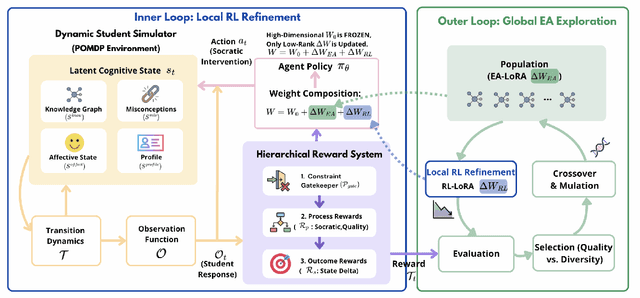
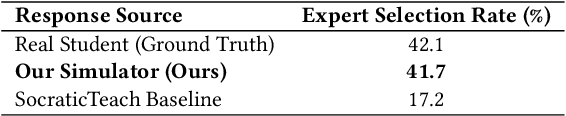
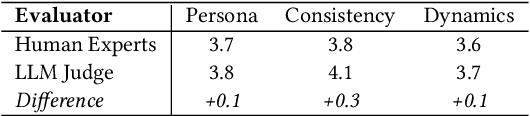
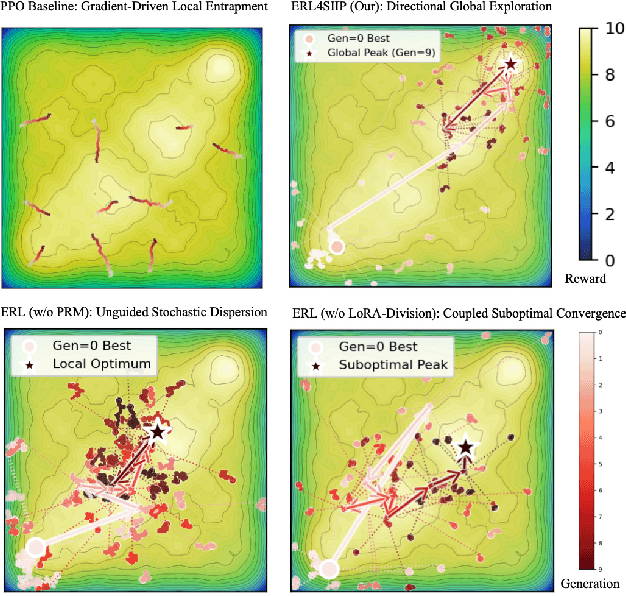
Cultivating higher-order cognitive abilities -- such as knowledge integration, critical thinking, and creativity -- in modern STEM education necessitates a pedagogical shift from passive knowledge transmission to active Socratic construction. Although Large Language Models (LLMs) hold promise for STEM Interdisciplinary education, current methodologies employing Prompt Engineering (PE), Supervised Fine-tuning (SFT), or standard Reinforcement Learning (RL) often fall short of supporting this paradigm. Existing methods are hindered by three fundamental challenges: the inability to dynamically model latent student cognitive states; severe reward sparsity and delay inherent in long-term educational goals; and a tendency toward policy collapse lacking strategic diversity due to reliance on behavioral cloning. Recognizing the unobservability and dynamic complexity of these interactions, we formalize the Socratic Interdisciplinary Instructional Problem (SIIP) as a structured Partially Observable Markov Decision Process (POMDP), demanding simultaneous global exploration and fine-grained policy refinement. To this end, we propose ERL4SIIP, a novel Evolutionary Reinforcement Learning (ERL) framework specifically tailored for this domain. ERL4SIIP integrates: (1) a dynamic student simulator grounded in a STEM knowledge graph for latent state modeling; (2) a Hierarchical Reward Mechanism that decomposes long-horizon goals into dense signals; and (3) a LoRA-Division based optimization strategy coupling evolutionary algorithms for population-level global search with PPO for local gradient ascent.
Surrogate-Assisted Evolutionary Reinforcement Learning Based on Autoencoder and Hyperbolic Neural Network
May 26, 2025Evolutionary Reinforcement Learning (ERL), training the Reinforcement Learning (RL) policies with Evolutionary Algorithms (EAs), have demonstrated enhanced exploration capabilities and greater robustness than using traditional policy gradient. However, ERL suffers from the high computational costs and low search efficiency, as EAs require evaluating numerous candidate policies with expensive simulations, many of which are ineffective and do not contribute meaningfully to the training. One intuitive way to reduce the ineffective evaluations is to adopt the surrogates. Unfortunately, existing ERL policies are often modeled as deep neural networks (DNNs) and thus naturally represented as high-dimensional vectors containing millions of weights, which makes the building of effective surrogates for ERL policies extremely challenging. This paper proposes a novel surrogate-assisted ERL that integrates Autoencoders (AE) and Hyperbolic Neural Networks (HNN). Specifically, AE compresses high-dimensional policies into low-dimensional representations while extracting key features as the inputs for the surrogate. HNN, functioning as a classification-based surrogate model, can learn complex nonlinear relationships from sampled data and enable more accurate pre-selection of the sampled policies without real evaluations. The experiments on 10 Atari and 4 Mujoco games have verified that the proposed method outperforms previous approaches significantly. The search trajectories guided by AE and HNN are also visually demonstrated to be more effective, in terms of both exploration and convergence. This paper not only presents the first learnable policy embedding and surrogate-modeling modules for high-dimensional ERL policies, but also empirically reveals when and why they can be successful.